How Much Does It Cost to Self-Publish a Book in 2026?

How Much Does It Cost to Self-Publish a Book

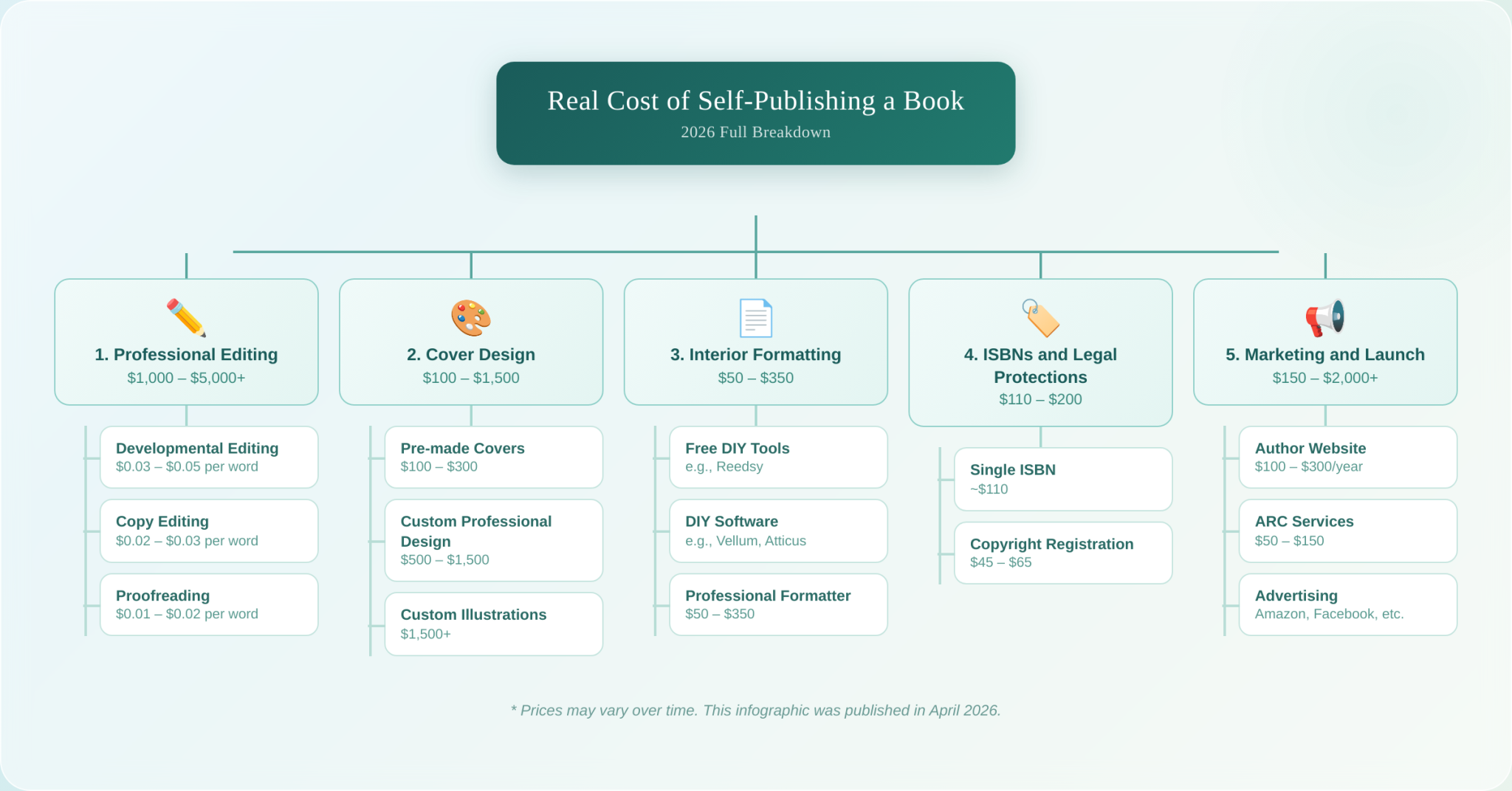
A professional self-published book commonly costs a few thousand dollars, but the defensible range is wide. Reedsy’s guide, updated March 3, 2026 and based on more than 230,000 freelancer quotes, estimates $2,940 to $5,660 for self-publishing. A heavily DIY release can cost far less; a complex illustrated book, full editorial program, audiobook, or sustained marketing campaign can cost much more.

The useful question is not “What is the cheapest possible upload?” Most major platforms let authors upload without a large setup fee. The useful question is “What must I spend to produce, identify, distribute, test, and market this specific book to the standard my readers expect?”

All prices below are U.S.-focused and were checked on August 5, 2026 unless another source date is stated. Fees, taxes, shipping, exchange rates, royalties, and provider terms can change, so verify the linked source before purchasing.

2026 Self-Publishing Cost Table

Budget item

Published price or benchmark What it covers Decision note

Source date

Professional self-publishing total

$2,940–$5,660

Typical professional indie production range Replace benchmark with actual quotes Reedsy, Mar. 3, 2026
Editing for 80,000 words

$2,160–$5,040

One or more editorial services Scope and manuscript condition drive price Reedsy, Mar. 3, 2026
Cover design

$930 average

Professional cover design benchmark Confirm formats, licenses, and revisions Reedsy, Mar. 3, 2026
Production and distribution

$0–$2,000

Formatting, files, and distribution-related work Complex interiors and formats cost more Reedsy, Mar. 3, 2026
Marketing

$60–$1,500

Indicative launch and promotion spending Set tests and stop-loss rules Reedsy, Mar. 3, 2026
KDP paperback No conventional setup fee; print cost deducted Amazon and Expanded Distribution royalties Amazon rate is 50% or 60% by price; Expanded is 40% Checked Aug. 5, 2026
IngramSpark $0 title setup; 1.875% Market Access Fee Current print-distribution fee structure Other service and revision fees may apply Price sheet Feb. 1, 2026
ISBN Services Basic $22.99 including barcode ISBN under Primedia publisher listing Stated platform incompatibilities must fit the plan Checked Aug. 5, 2026
ISBN Services Custom $109.99 including barcode Customer name or company in publisher field No incompatible services shown in comparison Checked Aug. 5, 2026
Bowker ISBNs 1 for $125; 10 for $295 Direct U.S. agency ISBN allocation Ten-pack is cheaper than three $109.99 Custom ISBNs Checked Aug. 5, 2026
U.S. copyright registration $45 Single; $65 Standard Electronic registration filing Use the lower fee only when eligible Checked Aug. 5, 2026
Proof copies Print cost plus shipping, tax, and corrections Physical quality-control cycle Budget more than one round when risk is high Project-specific

Why Self-Publishing Budgets Vary So Much

Word count and manuscript condition

Editing is usually the largest production expense. A clean 50,000-word manuscript that needs one copy edit is not comparable with a 100,000-word first draft needing developmental, line, copy, and proof stages. Reedsy’s 2026 benchmark puts editing for an 80,000-word book at $2,160 to $5,040 depending on the services included.

Genre and content complexity

A text-led novel is less complex to design than a cookbook, textbook, workbook, children’s picture book, or heavily illustrated nonfiction title. Tables, equations, citations, indexes, permissions, custom art, maps, and color printing add specialist labor and proofing cycles.

Number of formats

An ebook, paperback, hardcover, large-print edition, and audiobook are separate production jobs and separate products. Each can require its own files, cover specifications, quality checks, metadata, and identifier. More formats can expand reach but also multiply setup and maintenance costs.

DIY skill and opportunity cost

Free tools can reduce cash spending, but they do not make labor free. Track research, revision, formatting, proofing, upload, metadata, website, and campaign hours. A “$0” format that consumes 40 hours may cost more than hiring help if it delays release or produces expensive errors.

Distribution and ownership choices

A free or lower-cost identifier can be sensible for a platform-limited test, but it may place another company in the publisher field or restrict compatible services. A publisher-owned or Custom ISBN costs more because it supports a different control and compatibility outcome. Price comparisons must compare the same rights, metadata role, and channel access.

What to Budget for Each Stage

1. Editing

Choose the editorial service that solves the manuscript’s actual problem. Developmental editing addresses structure, argument, plot, pacing, and organization. Line or copy editing improves language, clarity, consistency, and correctness. Proofreading is the final check after the interior is typeset or formatted.

Ask for the scope, word count, sample edit, style guide, number of passes, schedule, revision policy, and deliverables. Do not add three editing stages automatically if a qualified assessment shows that one or two are sufficient. Do not use proofreading as a substitute for structural work.

2. Cover and interior production

Cover quotes should state whether they include ebook, paperback, and hardcover files; stock-image or font licenses; source files; revisions; spine changes; and marketing graphics. Interior quotes should list formats, complexity, correction rounds, accessibility needs, and whether future revisions cost extra.

Reedsy’s March 2026 guide reports an average cover-design cost of $930 and a broad $0 to $2,000 production-and-distribution category. Treat these as market benchmarks, not promises. Get quotes using the same brief so the proposals are comparable.

3. ISBNs and publisher identity

ISBN Services currently lists a Basic ISBN with barcode at $22.99. Its comparison states that Primedia eLaunch LLC is listed as publisher and identifies KDP print editions, Lulu, Amazon Seller Central/FBA, and IngramSpark/Lightning Source as incompatible services. The page also states that royalties and publishing rights remain the customer’s.

The Custom ISBN with barcode is listed at $109.99, places the customer’s name or company in the publisher field, and shows no incompatible services in the comparison. That price can be attractive when one or two formats need individual identifiers and the included service/support fits the publishing plan.

Bowker’s U.S. agency storefront lists one ISBN at $125 and ten at $295. A direct ten-pack can make financial sense for a publisher planning several formats or titles. The cheapest line item is not automatically the best value: compare publisher-of-record, compatibility, included barcode, metadata workflow, quantity, support, and future release plans.

4. Copyright registration and permissions

Copyright exists separately from ISBN assignment. The U.S. Copyright Office fee schedule lists $45 for the eligible online Single Application and $65 for the Standard Application. Eligibility matters; not every book or ownership structure can use the lower-cost option.

Also budget for permissions when the manuscript uses licensed images, maps, long quotations, song lyrics, tables, or third-party material. Legal review, trademark checks, sensitivity review, fact-checking, and indexing are separate services when needed.

5. Platforms, printing, and proofs

KDP calculates paperback royalties as royalty rate multiplied by list price, minus printing cost. Its current U.S. table applies a 50% rate at $9.98 or below and 60% at $9.99 or above; Expanded Distribution uses 40% minus printing cost. Printing cost varies by marketplace, page count, ink, and other specifications.

IngramSpark’s price sheet dated February 1, 2026 lists no title setup fee and a Market Access Fee of 1.875% of the local list price at the time of sale, with other service and revision fees addressed in the sheet. Always model per-sale fees and revision costs, not just account setup.

Order proofs before launch. A proof budget includes print cost, shipping, tax, possible customs, replacement copies, and another round after corrections. Color, hardcover, large trim, and international delivery change the total.

6. Marketing and launch

Reedsy’s 2026 guide gives a $60 to $1,500 marketing range. Marketing can also be $0 or much higher depending on audience, ads, publicity, email software, advance copies, promotions, events, author website, and content production.

Separate one-time launch spending from ongoing monthly spending. Set test budgets, success metrics, stop-loss rules, and a cash reserve. No paid campaign guarantees sales, rankings, reviews, or return on investment.

Three Worked Budget and Break-Even Scenarios

Scenario 1: One professional 80,000-word release

Use Reedsy’s published $2,940 to $5,660 total as a planning band for a professional self-published book, then replace every line with real quotes. If the paperback follows KDP’s example of a $15 list price, 333 black-ink pages, and a $5 print cost, the royalty is $4 per Amazon sale.

At $4 per copy, recovering $2,940 requires 735 net paid copies, while recovering $5,660 requires 1,415. Those are production-cost break-even figures only. Returns, ads, discounts, taxes, wholesale channels, free copies, and time can raise the true threshold.

Scenario 2: One title in three ISBN-bearing formats

A paperback, hardcover, and separately identified ebook need three ISBNs. Three ISBN Services Custom ISBNs at $109.99 each total $329.97. Bowker’s ten-pack at $295 is $34.97 less and leaves seven identifiers for future formats or books. One direct Bowker ISBN at $125 would total $375 for three if purchased individually.

This is a quantity break-even, not a universal winner. The Custom option includes a barcode and service workflow; direct agency allocation provides a larger block. Compare compatibility, publisher listing, barcode needs, support, and the probability that unused identifiers will actually be assigned.

Scenario 3: Basic versus Custom ISBN for one paperback

The cash difference between the listed Basic price of $22.99 and Custom price of $109.99 is $87. The Basic option lists Primedia eLaunch LLC as publisher and has stated platform incompatibilities. The Custom option lists the author’s name or company and shows no incompatible services.

If the release plan requires KDP print, IngramSpark, the author’s own publisher name, or portable distribution, the lower Basic price does not satisfy the same requirement. If the planned channel is compatible and the publisher-field trade-off is acceptable, the Basic option may fit. Decide from the distribution map, not the sticker price.

Hidden Costs Authors Commonly Miss

  • Second proof rounds, corrected file uploads, and cover-spine changes after page count shifts.
  • Stock images, fonts, illustrations, maps, permissions, indexing, fact-checking, and legal review.
  • Hardcover, large-print, translation, audiobook, and international metadata production.
  • Shipping, tax, customs, event inventory, storage, damaged copies, and returns.
  • Author website renewals, email software, ad creative, ARC services, publicity, and ongoing campaigns.
  • Platform fees, print costs, wholesale discounts, retailer margin, and lower royalty channels.
  • Time spent learning tools, coordinating vendors, correcting files, and managing distribution.
  • A contingency reserve for changes after accessibility, retailer, or proof review.

Self-Publishing Budget Decision Checklist

  • Define the reader, genre, quality benchmark, formats, territories, and launch date.
  • Lock the manuscript and word count before requesting final production quotes.
  • Identify the editorial problem before selecting an editing service.
  • Request comparable written scopes, deliverables, revision rounds, licenses, and deadlines.
  • Choose ISBN type and quantity from publisher identity, compatibility, and future formats.
  • Model printing, royalty, wholesale, platform, and revision fees per channel.
  • Calculate break-even units using net contribution per sale, not list price.
  • Budget at least one proof-and-correction cycle and a contingency reserve.
  • Separate production budget from marketing tests and ongoing monthly spend.
  • Verify every price and term on the provider’s current page before checkout.

Frequently Asked Questions

Can you self-publish a book for free?

You can upload to some platforms without a setup charge and use free production tools, but professional editing, design, identifiers, proofs, permissions, marketing, and author time can still create real costs.

What is the biggest self-publishing expense?

For many text-led books, editing is the largest production line. Illustrated books, audiobooks, complex nonfiction, or aggressive campaigns can shift the largest cost to art, narration, permissions, or marketing.

Does KDP charge to publish a paperback?

KDP’s business model deducts printing cost from royalties rather than charging a conventional per-title print run. Use its current calculator and royalty table because list-price thresholds, marketplaces, page count, and ink affect earnings.

Do I need to buy an ISBN?

It depends on format and channel. A Kindle ebook does not require one, while print and wide-distribution plans may use a free platform ISBN, Basic ISBN, Custom ISBN, or agency allocation with different publisher and compatibility implications.

How much should I reserve for marketing?

Start from a test plan, not a promised outcome. Define the audience, channel, creative, measurement period, success metric, and stop-loss. Scale only after the data supports it.

How do I calculate book break-even?

Divide total recoverable investment by net contribution per paid unit. Net contribution is the royalty or receipt after print cost, platform or distributor deductions, discounts, refunds, and variable marketing costs.

The Bottom Line

A credible 2026 self-publishing budget is built from the book’s scope and current quotes, not a universal package price. Use dated market benchmarks to set a range, then model product ownership, format count, platform fees, print economics, proof cycles, and marketing separately. Spend first on the constraints readers notice and the infrastructure the distribution plan actually requires.

Share This Post

More To Explore

We Can Help

drop us a line and keep in touch

Cyber Monday Offer End In

Hours
Minutes
Seconds