
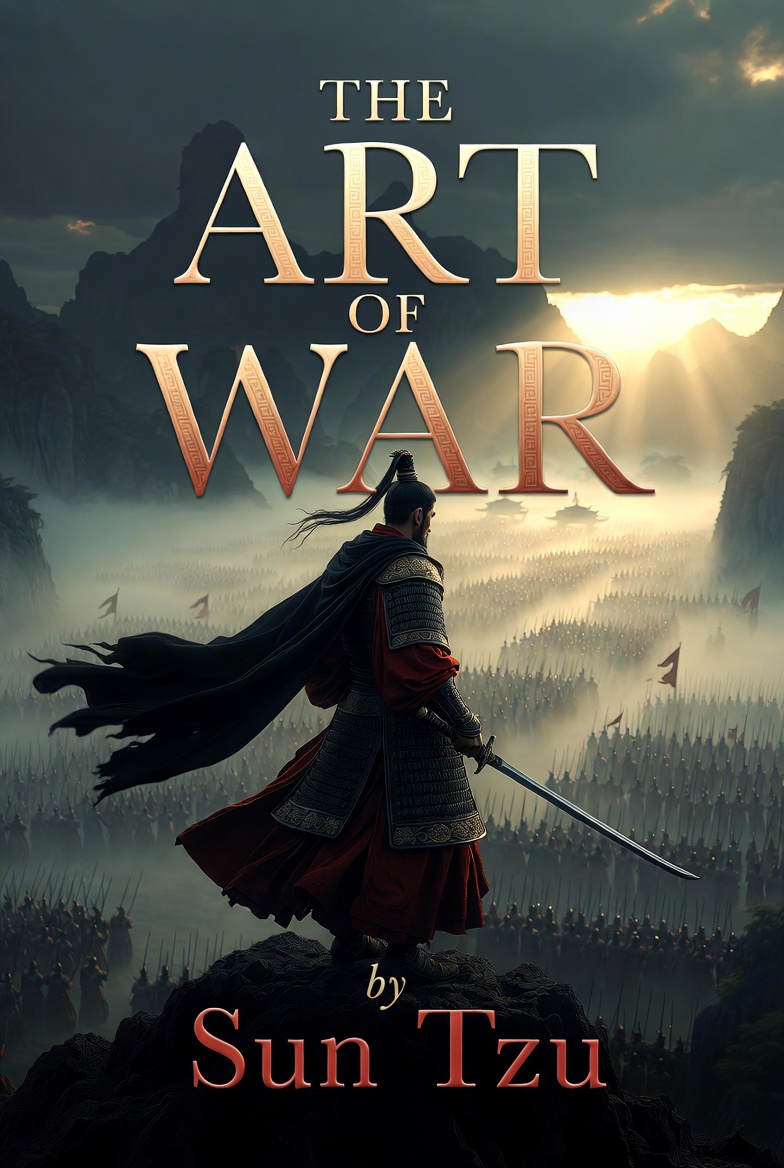
The Art of War cover
Sample Playbook — Historical Edition
Sample Playbook — Modern 2026 Edition

The Art of War

by Sun Tzu

Military Strategy / Leadership Philosophy / Self-Help · 500 BC

📜
Historical Edition. This shows what a marketing plan for The Art of War might have looked like if Sun Tzu had access to a structured marketing framework in 500 BC. Every recommendation is grounded in the real publishing and distribution channels of the era. Use the toggle above to see the modern 2026 version.
🚀
Modern 2026 Edition. This is what a publisher's marketing plan for The Art of War would look like if it were released as a brand-new book today — using Amazon, BookTok, Substack, and the full toolkit of modern book marketing. This is exactly what your own playbook will look like.

Target Reader

The ideal reader in 500 BC was a ruling lord (zhūhóu) or his senior military commanders — literate aristocratic men trained in the six arts, accustomed to receiving counsel in written form on bamboo or silk. Secondary readers included court advisors (qīngdàifū), hereditary ministers, and the retainers responsible for managing a state's military campaigns. Literacy in this period was the exclusive province of the nobility and a thin stratum of educated officials; women were almost entirely excluded from military discourse and court strategic counsel. These men read not for entertainment but for advantage — they consumed texts the way a general studies terrain: for actionable intelligence that could determine whether their state survived the next season of warfare.

Optimized Book Description

Copy and paste this into your KDP dashboard under Book Description.

The 500 BC equivalent of an Amazon product page — a presentation copy inscription or herald's announcement delivered to a lord's court chamberlain before an audience with the king.

Presented to the Court of King Helü of Wu by Sun Wu, formerly of the state of Qi, general and strategist:

My lord, the states of the Central Plains do not perish for want of soldiers. They perish for want of method. An army of ten thousand led without system is ten thousand men walking toward their own graves. An army of five hundred led with understanding of ground, of fire, of the nine varieties of terrain, of the five weaknesses in an enemy's general — that army wins before it draws a blade.

These thirteen chapters contain the whole of that understanding.

The first chapter teaches you to calculate victory before the campaign begins — not with hope, but with five measurable factors that determine outcome before a single order is given. The chapters that follow address the management of direct and indirect force, the exploitation of weakness, the use of fire, and the employment of spies. Nothing is omitted. Nothing is included that is not necessary.

The system has been tested. Upon your lord's own grounds, with no soldiers but the palace household, these principles produced disciplined, responsive, unified action within a single afternoon. The method works with unwilling subjects of no military training. Consider what it produces with soldiers.

Thirteen chapters. Memorizable on campaign. Applicable before any enemy, on any ground, in any season.

A lord who has read these chapters and a lord who has not are not fighting the same war.

This text is presented for your lord's personal study and for transcription to his senior generals. Copies may be commissioned through the court scribal office at terms to be arranged with the chamberlain.

Backend Keywords

Enter each phrase in its own keyword field in KDP (up to 7 fields).

#Phrase
1 bīngfǎ — military methods or laws of warfare
2 móu — strategic planning and deliberation before action
3 quán — the weighing of advantage; situational calculation
4 zhì — stratagems; the use of cunning and deception in command
5 zhèng qí — the orthodox and unorthodox; the theory of direct and indirect force
6 jiāng — the qualities and duties of a general; command philosophy
7 zhī — foreknowledge; intelligence and the use of spies

These are the classical Chinese terms that educated military readers, court advisors, and scribal officials of the Spring and Autumn period used to categorize, discuss, and request texts on the conduct of war. They function as the 500 BC equivalent of Amazon search keywords — the vocabulary a lord's chamberlain or a general's aide would use when asking a court archivist whether a relevant text existed. Placing these concepts prominently in any presentation copy or herald's announcement ensures the text is correctly identified and routed to decision-makers who are actively seeking this type of counsel.

Price Recommendation

No currency price — presentation copies to lords and generals at no charge, with the expectation of appointment or ongoing patronage as compensation. Scribal copies commissioned by secondary recipients at the cost of materials plus the scribe's fee, typically two to three bolts of silk for a complete thirteen-chapter set on bamboo strips with silk binding.
In 500 BC, the commercial book market as understood in later eras did not exist. Texts circulated through gift, commission, and patronage networks. The correct pricing strategy for The Art of War is not monetary but positional: the presentation copy to King Helü is free, because the return is not coin but command authority and state resources. Secondary circulation — copies made for generals, allied lords, or court advisors — was compensated through the cost of materials and scribal labor. Attempting to charge a lord directly for counsel would have been a significant social error and would have undermined the text's authority. The economic model is closer to a consulting retainer than to retail publishing.

KDP Select / Kindle Unlimited

Complete volume, presented in full to the primary patron first — do not serialize.
Serialization as a distribution strategy — releasing the thirteen chapters one at a time over successive audiences — would actively undermine the text's central argument. The Art of War's authority derives precisely from its completeness: thirteen chapters covering every material variable of warfare, nothing omitted, nothing superfluous. Presenting chapters piecemeal would invite the recipient to judge the system before it is fully visible, and would allow a rival court to reconstruct the method from partial information without ever granting Sun Tzu the audience he needs. The correct strategy is the one Sima Qian records: present all thirteen chapters at once to the highest-value patron available, demonstrate the system's principles in a controlled test, and secure appointment before any secondary distribution begins. Only after the primary patronage relationship is established should copies be commissioned for distribution to generals — and those copies should always be complete.
Direct court presentation to ruling lords (zhūhóu) Needs setup
In 500 BC, the primary channel for a strategic text was a formal audience with a ruling lord or his senior court officials. A general or advisor would request an audience through the court chamberlain, present a physical copy of the text (bamboo strips, bound with silk cord), and either deliver an oral summary or request that the lord's scribes read it aloud at court. This was not a public event — it was a closed, high-stakes pitch meeting. The Shiji records that Sun Tzu's audience with King Helü of Wu followed exactly this pattern.
Why it matters: For a military strategy text in 500 BC, the ruling lord was not merely the best reader — he was the only reader who could act on the material in any meaningful way. A general without a lord's commission had no army to command. Distribution to anyone below the lord level was secondary; the entire chain of adoption ran through the throne room. Without this channel, the book has no practical effect regardless of its quality.
Action: Request a formal audience with King Helü of Wu through his court chamberlain, presenting credentials from your previous service in Qi. Prepare a physical presentation copy — bamboo strips of the finest quality, bound with red silk cord appropriate to a gift for royalty. Commission a brief herald's summary (no more than one hundred characters) for the chamberlain to present before the audience is granted. Prepare a live demonstration: offer to prove the method's principles using whatever subjects the king nominates, under whatever conditions he sets. Do not leave the text without a demonstration — the Shiji record of the palace concubine drill is not a curiosity, it is the correct sales strategy.
⏱ Three to six weeks to secure the initial audience through proper court protocol; the demonstration itself can be concluded in a single afternoon.
Court scribal distribution to senior generals Needs setup
Once a lord adopted a text, his court scribes would produce copies for distribution to the generals and ministers who needed to act on it. In the state of Wu in 500 BC, this meant the royal scribal office (shǐ) copying the thirteen chapters onto bamboo strips for each senior commander. The author had no direct control over this process once the lord had accepted the text — but he could influence it by making the text physically easy to copy (clear, consistent characters, logical strip-by-strip structure) and strategically important enough that the lord ordered wide distribution rather than keeping it restricted.
Why it matters: A text that reaches only the king reaches one reader. A text the king orders copied for his five senior generals reaches six readers who can each test and validate the method in the field. Field validation generates the word-of-mouth — or in this case, court-report-of-mouth — that causes allied lords and enemy-state defectors to seek out the text. The scribal distribution network is the 500 BC equivalent of a publisher's sales force.
Action: Design the thirteen chapters with scribal reproduction in mind: use a consistent, legible clerical script (lìshū precursors of the era); number the chapters clearly; begin each chapter with its title and central principle so a scribe copying a damaged strip can reconstruct context. After securing King Helü's patronage, formally request that copies be made for the five senior Wu generals. Offer to supervise the first copying session to ensure fidelity. Each copy is a new reader with command authority.
⏱ Two to four weeks per copy set, depending on scribal availability; plan for simultaneous copying of multiple sets once royal commission is confirmed.
Cross-state diplomatic and military correspondence networks Needs setup
The Spring and Autumn period was characterized by dense diplomatic traffic between the feudal states — lords exchanged envoys, negotiated alliances, and maintained ongoing correspondence through traveling diplomats (shǐ). Military advisors and strategists who had demonstrated success in one state were frequently head-hunted by rival lords. This correspondence network was the era's most effective long-distance distribution channel: a successful general in Wu whose method was discussed in an envoy's report to the state of Qi was, in effect, receiving a review in the most widely-read publication available.
Why it matters: The Art of War's potential readership was not limited to Wu. Every lord in the Central Plains faced the same existential problem — survival against better-resourced enemies — and would have been intensely interested in a demonstrated military method. The diplomatic network was the mechanism by which a text's reputation could cross state borders without the author traveling. Sun Tzu's victories as a Wu general would function as the reviews; the method's association with those victories was the marketing.
Action: Ensure that after each significant Wu military victory, the strategic method used is attributable — in debriefs, in reports to the king, in conversations with diplomatic visitors — to the systematic principles of the thirteen chapters rather than to luck or individual heroism. When foreign envoys visit the Wu court, be available for informal conversations about military philosophy. Do not share the full text with foreign courts until Wu's strategic position is secured, but allow the reputation of the method to circulate freely.
⏱ Ongoing from the moment of the first court presentation; meaningful cross-state reputation typically required two to three years of demonstrated military success.
Itinerant advisor (yóushuì) networks Needs setup
The Spring and Autumn and early Warring States periods saw the rise of itinerant advisors — educated men who traveled from court to court offering their expertise to whichever lord would hire them. These men (the yóushuì, or 'traveling persuaders') were the era's professional knowledge workers, and they formed a loose but effective information network. A persuader who had read The Art of War at the Wu court and moved to service at the court of Chu would carry knowledge of the text with him. Over time, these men functioned like traveling book reviewers with direct access to decision-makers.
Why it matters: Yóushuì networks were how ideas moved between courts faster than official diplomatic channels. A text that was known to circulate among these advisors acquired a kind of pan-state authority — it was the thing educated men of affairs had read, or needed to read. For a military strategy text, endorsement by well-connected itinerant advisors was the equivalent of a strong recommendation from a well-regarded critic.
Action: Identify the most respected itinerant military advisors currently operating in the Wu-Chu-Qi corridor. Request that King Helü arrange introductions to two or three such men during their court visits. Present them with personal reading copies — not as gifts, but as loans for commentary. Invite written responses. A favorable written response from a recognized yóushuì was the closest 500 BC equivalent to a published review and carried significant weight with prospective patron-readers.
⏱ Three to six months to identify, meet, and secure commentary from two or three well-placed itinerant advisors.

Skip for now

Distribution to states outside the Wu-Qi-Chu triangle: In 500 BC, Sun Tzu's strategic priority must be securing and maintaining his position at the Wu court. Wide distribution of the thirteen chapters to distant states — Jin, Qin, Yan — before the method has been validated in the field risks two things: gifting a strategic advantage to a potential enemy of Wu, and diluting the text's authority by allowing it to circulate without the supporting evidence of actual victories. Focus distribution on the Wu court and the immediate diplomatic network until at least two major Wu military successes can be attributed to the method. Cross-state distribution to distant lords is a second-phase strategy, appropriate once the text's military reputation is established and Sun Tzu's appointment is secure.

Pre-Launch

Four weeks before the court presentation to King Helü

  • Commission the finest available bamboo strips from Wu's court supply stores and engage the most skilled court scribe to produce the presentation copy — the physical quality of the object signals the seriousness of the content. Red silk binding cord, not leather. The presentation copy should be beautiful enough that King Helü will want to display it before he reads it.
  • Prepare and memorize a spoken précis of each of the thirteen chapters — no more than thirty seconds per chapter — so that if the chamberlain allows only a brief audience, Sun Tzu can deliver the entire architecture of the system orally and leave the physical text as a follow-up gift.
  • Identify which of King Helü's current senior advisors has the most influence over military appointments, and arrange an informal meeting through a mutual connection. Present the advisor with a summary of the system's principles — not the full text — and invite his questions. His favorable impression before the royal audience will smooth the path considerably.
  • Prepare the concubine demonstration logistics in advance: identify a clear, flat drilling ground visible from a position where the king can observe; draft the command sequences you will use; anticipate where discipline will break down and prepare your response. The Shiji account suggests Sun Tzu executed two palace officials who laughed during the drill — have a clear, calm plan for handling non-compliance before you are in front of the king.
  • Draft a brief written statement — no more than fifty characters — summarizing the central argument of the text, suitable for the chamberlain to read aloud when announcing the audience. 'Sun Wu of Qi presents thirteen chapters on the methods of warfare, by which any army may be made to win.' Simple, falsifiable, inviting the king to test the claim.

Launch Week

The week of the royal audience and the two weeks following

  • Deliver the presentation copy and conduct the demonstration on the same day — do not allow the king to read the text before seeing it proven. The demonstration is the review; the text is the permanent record of what the demonstration proved.
  • Immediately following appointment as general, commission five additional copies of the thirteen chapters for the senior Wu commanders. Personally brief each general on the chapter most relevant to his current operational responsibility — this creates individual ownership of specific sections and makes each general an advocate for the whole.
  • Request that King Helü authorize a court scribe to record the demonstration and its outcome as an official court document. This record becomes the earliest third-party validation of the method — the 500 BC equivalent of a publisher's testimonial page.
  • Arrange an informal evening audience with two or three of the most respected members of the Wu court — not military men, but ministers and administrators — and walk them through the five-factor analysis from Chapter One as applied to Wu's current strategic position versus Chu. This demonstrates that the method is not merely a soldier's tool but a governing instrument.
  • Send a brief written message to the Wu court's diplomatic contact at the state of Qi — Sun Tzu's home state — noting the appointment and the text that preceded it. This is not wide publication; it is strategic placement of a single data point in the network most likely to carry it forward.

Post-Launch

Months two through six after the court presentation

  • After the first military campaign in which the method is applied, prepare a written operational debrief for King Helü that explicitly maps each command decision to the relevant chapter and principle. This debrief is not a battle report — it is a proof document, showing that the method predicted the outcome before the campaign began. Circulate it among the senior generals.
  • Commission a second, slightly less elaborate set of copies — written on thinner bamboo, bound with plain silk — for distribution to allied court contacts and selected itinerant advisors. These are working copies, not presentation copies, and should be understood as loans rather than gifts, creating a reason for the recipients to maintain correspondence with Sun Tzu.
  • Identify the two or three most prestigious military advisors in the states immediately surrounding Wu — Chu, Yue, Qi — whose opinion would carry weight with their own lords, and arrange for them to receive word (through diplomatic channels, not directly) that the text exists and that copies may be obtained through the Wu court on terms to be negotiated. Let demand come to you rather than pushing supply outward.

Review Strategy

In 500 BC, there were no literary critics in the modern sense and no periodical reviews. The functional equivalents were three: the written endorsements of respected senior statesmen and generals (whose names attached to a text conferred authority on it), the oral reports of itinerant advisors who had read the text and discussed it at other courts, and the operational record of campaigns conducted according to its principles. Sun Tzu should pursue all three, in that order of priority. For the first category: after securing King Helü's appointment, request that the king's senior advisor Wuzixu — who had himself argued for Sun Tzu's appointment according to the Shiji — provide a written statement of his assessment of the thirteen chapters. Wuzixu was one of the most respected strategic minds of the era and his endorsement, attached as a preface to secondary copies, would function as the era's most powerful critical notice. For the second: when itinerant advisors visit the Wu court, make time for private conversations rather than formal presentations. A persuader who leaves a court believing he has been given privileged access to a method is more likely to discuss it favorably elsewhere than one who received a formal pitch. For the third: let the campaigns speak. Every Wu victory is a review. Ensure the method is visible in the victory.

Primary Channel: Direct patronage networks at the courts of the major Zhou feudal states

The court patronage network was the primary mechanism by which ideas, texts, and advisors moved through the Spring and Autumn period world. A lord who adopted an advisor also adopted, implicitly, the advisor's intellectual framework — and would recommend both to allies. When King Helü appointed Sun Tzu as a general, the appointment was itself a public signal to other lords: this method is serious enough that Wu stakes its military on it. The network of lords, their ministers, and their diplomatic representatives was the only scalable distribution system available for a text of this kind.

Why this platform for your book: Military strategy texts had no mass audience in 500 BC — they had a small number of readers with extreme decision-making power. A single additional lord-reader was worth more than a thousand educated-but-powerless readers, because only a lord could test the method at scale, generate the victories that validated it, and commission further copies. The patronage network was not the best channel for reaching a large audience; it was the only channel that reached the right audience.

What to post

A spoken précis of the five-factor analysis from Chapter One, adapted to the specific strategic situation of whichever court Sun Tzu is visiting — demonstrating the method's relevance in real time rather than in the abstract.
The framing question that opens Chapter One: 'Which lord has the Way? Which general has greater ability? Which side has the advantages of Heaven and Earth?' — asked directly of a court advisor about his own lord's current campaign. It is a question that makes the interlocutor realize they do not have a systematic answer.
An anecdote from the Wu campaign that illustrates a specific principle — ideally one where the method's prediction diverged from common wisdom and the method proved correct.
A diplomatic reframing of the text's value: not 'how to defeat enemies' (which implies aggression) but 'how to achieve your objectives with the minimum expenditure of resources' — a framing that appeals to the administrative and economic concerns of a ruling lord, not just his military ambitions.
The text's central paradox, offered as a conversation starter: 'The supreme art of war is to subdue the enemy without fighting.' A lord who hears this and wants to know how will ask for the text unprompted.

Time commitment: This is not a campaign with a defined end point — it is the ongoing work of a general-advisor's career. Budget one significant court interaction per month focused specifically on the text's reputation, in addition to regular military and administrative duties.

Secondary Channel: The emerging tradition of zǐ (master) literature and philosophical debate

The late Spring and Autumn period was the beginning of what would later be called the Hundred Schools of Thought — a period of intense intellectual competition among educated men offering systematic frameworks for governance, ethics, and strategy. While this tradition reached its peak in the subsequent Warring States period, its roots were already visible in Sun Tzu's era in the circulation of texts attributed to named masters. By positioning The Art of War within this tradition — as a systematic philosophical contribution rather than merely a practical military manual — Sun Tzu could reach the broader community of educated court advisors who consumed and debated these texts.

The primary patronage network reaches lords; the zǐ literature tradition reaches the advisors who counsel lords. An educated minister who has read and debated the thirteen chapters is likely to recommend them to his lord, and to frame them favorably. This is a slower channel than direct court presentation but produces more durable advocacy.

Getting started: Seek out opportunities to engage publicly — at court gatherings, at diplomatic receptions — with the ideas of other recognized masters circulating in the same period, particularly those whose frameworks touch on governance and the relationship between a ruler and his officials. Engaging respectfully but critically with existing intellectual frameworks positions the thirteen chapters as a contribution to an ongoing conversation rather than an isolated novelty.
Invite two or three recognized scholars or advisors to read the text and offer written responses — not endorsements, but genuine intellectual engagement. Responses, even critical ones, generate discussion, and discussion generates readers.
Consider composing a short supplementary text — not a new chapter, but a preface — that explicitly situates the thirteen chapters within the broader question of how a ruler maintains the loyalty of Heaven and the welfare of his people. This framing connects the military text to the governing philosophy debates that educated men were already having.


Your Email List

The period equivalent of an email subscriber list was a roster of named individuals — lords, generals, ministers, and senior advisors — to whom an author maintained active written correspondence. In 500 BC, this correspondence traveled by foot messenger or diplomatic courier. The list was not a commercial subscription but a relationship: each correspondent received occasional written communications (brief strategic observations, responses to current events, follow-up questions) that kept the author's ideas present in their thinking without requiring a formal court visit.

How to start

After each court presentation or significant diplomatic contact, record the name, title, and state of the recipient in a formal register. Assign a trusted aide to maintain this register and to prompt Sun Tzu when more than three months have passed without contact with a high-priority correspondent. Send brief written observations — one bamboo strip, not thirteen — tied to current events: a note on the strategic implications of Chu's recent border movements, a question about whether a correspondent's current campaign aligns with the terrain principles of Chapter Ten. Keep the correspondence short enough to be read immediately and substantive enough to be worth keeping.

Reader magnet idea: Offer senior correspondents an exclusive supplementary document: a worked application of the five-factor analysis from Chapter One to the specific strategic situation of their state, prepared personally by Sun Tzu based on available intelligence. This bespoke strategic assessment — perhaps twenty strips of bamboo — demonstrates the method's power more convincingly than the abstract text alone, and gives the recipient something of immediate practical value that they cannot obtain from the text itself. It is the 500 BC equivalent of a free strategy session: high effort, high reward.

Reader Communities

The court advisory circle of the state of Qi Court advisory network
Qi was one of the dominant intellectual states of the Spring and Autumn period and the home state Sun Tzu had left before entering Wu's service. The Guanzi tradition — texts associated with the great Qi statesman Guan Zhong — was already establishing a framework for thinking systematically about governance and military affairs. The educated advisors at the Qi court were the most likely peer audience for a text like The Art of War, and Sun Tzu's Qi origins gave him a legitimate reason to seek their engagement. A favorable reception at the Qi court would carry particular weight because Qi and Wu were geopolitical rivals — endorsement from an intellectual community associated with a rival state was more credible than endorsement from allies.
How to engage: Use the diplomatic relationship between Wu and Qi to arrange an informal meeting with two or three senior Qi court advisors during the next round of inter-state negotiations. Do not present the text formally — offer it as a conversation piece, a basis for discussion about military philosophy. Ask questions rather than making arguments. A Qi advisor who feels he has contributed to the development of the method is more likely to advocate for it than one who feels he has been lectured at.
The network of graduates from the Zhou royal archery and chariot schools Professional military training network
The Zhou aristocratic education system — the six arts (liù yì): ritual, music, archery, charioteering, writing, and mathematics — produced a cohort of educated military men who shared a common technical vocabulary and a common set of professional concerns. Men who had trained together at the royal schools or under the same regional masters maintained relationships across state lines throughout their careers. This network was the most natural peer community for a military strategy text — these were men who took the technical dimensions of warfare seriously as a subject of study, not merely as a practice.
How to engage: Identify which of the senior Wu generals and visiting military advisors share training connections with men serving at other courts. Use these connections to arrange informal readings — not formal presentations, but the kind of professional conversation that happens between men who share a common discipline. Frame the thirteen chapters as a contribution to an ongoing professional conversation about method, not as a finished doctrine to be accepted or rejected.

Publication Announcement

Send to your list or personal contacts on launch day.

To: Your email list
Subject: Sun Wu of Qi presents thirteen chapters on the complete methods of warfare — copies available through the Wu court on terms to be negotiated
To the Honorable [RECIPIENT NAME], in respectful greeting:

You will have heard, through the reports of your state's envoys to the court of Wu, that King Helü has appointed the undersigned as general following a demonstration of the methods described herein. The appointment has since been tested in the field. The record of those campaigns is now a matter of diplomatic report, and I will not rehearse it here.

What I write to bring to your attention is the text that preceded the appointment: thirteen chapters on the methods of warfare, addressing in systematic form the calculation of advantage before a campaign begins, the management of direct and indirect force during engagement, the use of terrain, fire, and foreknowledge, and the qualities a general must possess and those he must avoid.

The text is compact. A general on campaign can carry it. A lord can read it in a single evening. Its principles can be tested before a single soldier is committed.

If your lord would wish to examine a copy, or to arrange a discussion of its application to your state's current strategic circumstances, I am prepared to correspond further or to receive an envoy at the Wu court at a time convenient to your lord's schedule.

Written in the service of Wu, by Sun Wu, formerly of Qi.

Requests for copies should be directed to the court chamberlain of the state of Wu.

Social Posts

ARC Request Email

Send to bloggers and reviewers before your release date. Replace [REVIEWER_NAME] and [BOOK_LINK].

To: [Reviewer Name]
Subject: A copy of thirteen chapters, sent for your commentary — Sun Wu of Qi to [CRITIC_NAME]
To [CRITIC_NAME], whose reputation for clear judgment in matters of strategy and governance I have had occasion to hear spoken of with respect at several courts:

I write not to ask for your approval — a man of your experience will offer his honest assessment regardless of what the author hopes to hear — but to ask for your attention.

Enclosed with this letter are thirteen chapters on the methods of warfare, composed over [years] of study and tested in the field during the campaigns conducted under King Helü of Wu. The text addresses, in systematic form, everything a general requires to calculate the outcome of a campaign before it begins and to manage that campaign intelligently once it has started.

I have sent this copy to you specifically because the question of whether the system is complete — whether any material variable of warfare has been omitted — is one that only a man of your experience can answer credibly. If you find a gap, I would genuinely wish to know of it.

If your assessment, upon reading, is that the text merits wider attention among the lords and generals of the Central Plains, I would be grateful for any word you might put in its favor at courts where your judgment is respected. If your assessment is otherwise, I trust you will say so directly.

In either case, the copy is yours to retain.

Respectfully submitted, Sun Wu, General of Wu.

Author Bios

Short (Amazon, Goodreads, BookBub)

Sun Wu, known as Sun Tzu, served as General of the state of Wu under King Helü of the Spring and Autumn period, having previously studied the military arts in his native state of Qi. He is the author of thirteen chapters on the methods of warfare, which preceded his appointment and have since been applied in the field. He is available to lords and court advisors seeking consultation on strategic method.

Long (Website, press kit)

Sun Wu — styled Sun Tzu, Master Sun — was born in the state of Qi during the reign of the Zhou kings, into a family with a tradition of military service that provided him both the education and the practical formation from which his system of warfare derives. After conducting his studies and early service in Qi, he came to the attention of Wuzixu, the senior minister of the state of Wu, whose recommendation brought him before King Helü. He presented the king with thirteen chapters on the complete methods of warfare — a system covering every calculable variable of military conflict from pre-campaign analysis to the use of spies — and was subsequently appointed General of Wu. The campaigns conducted under his command have since provided the field evidence that the thirteen chapters predicted. He is currently engaged in the ongoing strategic direction of the state of Wu's military affairs, and accepts written inquiries from courts seeking consultation on the application of his method to their specific circumstances.
This is the 500 BC equivalent of Amazon Ads — the question of which paid or placed communications Sun Tzu should invest in to accelerate the text's reach. The correct paid strategy in 500 BC is not handbills or posted notices (literacy rates outside the court elite were negligible and the text's audience was never the general population). The equivalent investment is in the physical quality of presentation copies and in the cost of diplomatic couriers to carry correspondence to high-value contacts at distant courts. Spend on material quality first — a presentation copy that looks like the work of a man who expects to be taken seriously is worth ten adequate copies. Spend on courier access second — a letter that reaches a lord's chamberlain directly, rather than being passed through intermediaries, arrives with its urgency intact.
ℹ Readiness check: Do not invest in wide distribution of copies until at least one major Wu military victory can be cited as evidence of the method's validity. A text distributed before it has a track record is competing purely on argument; a text distributed after a documented victory is competing on evidence. The concubine demonstration proved the method could work under controlled conditions. The first successful campaign will prove it works under real ones. Wait for that proof before spending resources on copies for secondary or tertiary audiences. The readiness signal is this: when foreign envoys at the Wu court begin asking about the text unprompted, distribution has begun to pull. Until that happens, push only to the highest-priority targets.

Ad Headlines

Use in Sponsored Products "Custom text" field. Test both.

Headline 1
Thirteen chapters. No campaign lost.
Falsifiable, concrete, and precisely the kind of claim a lord in an existential military situation needs to hear. It does not promise victory — it implies a track record. In an era where military advice was abundant and mostly anecdotal, a claim with implied empirical backing was the most compelling possible differentiator.
Headline 2
The method Wu used. Ask what changed.
Uses Wu's documented military reputation as social proof without requiring the reader to take the author's word for anything. Instructs the reader to verify — which is both honest and strategically smart, because verification means seeking out more information, which creates another engagement opportunity.

Keyword List

Placement strategy: focus diplomatic correspondence and courier effort on the courts of states currently engaged in active military conflict or facing immediate strategic threats. A lord who is not at war has no urgent reason to read a military strategy text; a lord whose border is contested will read it this week. Within courts, target the chamberlains and senior military ministers first — they are the gatekeepers who decide what reaches the lord's attention. Avoid distributing copies to junior officials who lack both the authority to act on the text and the credibility to advocate for it upward.

Competitor Titles Genre Terms Reader Behavior
The administrative and military writings attributed to Guan Zhong of Qi (the Guanzi tradition) — the dominant competing framework for systematic governance and military management Bīngfǎ — military methods; the systematic approach to the conduct of war Lords and senior ministers who received counsel from itinerant advisors and sought written frameworks to systematize what they had heard orally
The ritual warfare texts preserved in Zhou court archives — the traditional framework The Art of War explicitly displaces Móuchén — strategic counsel; the genre of advice offered to rulers by expert advisors Generals preparing for campaigns who required portable, memorizable reference systems for command decisions
Oral tactical traditions attributed to named commanders of the early Zhou period, circulated as anecdote rather than system Zhìmóu — the use of stratagems and intelligence rather than brute force Court archivists and scribal officials responsible for maintaining a state's repository of strategic knowledge
The administrative texts on logistics and resource management circulating among the states of the Central Plains Bīngshū — military writings; texts devoted to the theory and practice of warfare Diplomatic envoys who needed to understand the military doctrine of the states they were negotiating with
The diplomatic and strategic counsel offered by itinerant yóushuì advisors — the live human competition for the same advisory role Sun Tzu's text seeks to fill Quánshù — the art of weighing circumstances; texts offering frameworks for situational calculation Men who had previously consulted the Guanzi tradition on governance and were ready for a more specifically military analytical framework

Bid & Budget

Starting bid
The cost of three complete presentation-quality copies — finest bamboo strips, red silk binding, scribal fee for clean copying — delivered by royal courier to the courts of the three lords currently facing the most acute military threats. Estimate: twelve to fifteen bolts of silk in total, including courier fees. This is the minimum meaningful spend for a single distribution round.
per click
Daily budget
One presentation-quality copy per month to a new high-priority court contact, plus courier correspondence to three to five existing contacts. Sustainable ongoing spend without depleting the resources of a newly appointed general operating on a court stipend.
to start
The signal that the advertising is working is not bookseller orders — there are no booksellers. The signals are: (1) foreign envoys at the Wu court asking specifically about the text without having been prompted; (2) a lord from another state requesting a personal meeting with Sun Tzu rather than the other way around; (3) a copy of the text appearing at a third court that Sun Tzu did not directly supply, indicating organic reproduction. When any of these signals appears, increase the pace of diplomatic correspondence and offer to arrange direct consultations. When none of these signals appears after three months of active distribution, reassess the target list — the problem is likely that the current recipients lack either the authority or the urgency to act, not that the text is weak.

This Week

  • Commission the presentation-quality bamboo copy: identify the best available court scribe, secure first-grade bamboo strips from the court supply, specify red silk binding cord, and set a completion date of no more than twelve days. The physical object must be ready before you can request the audience.
  • Draft the fifty-character herald's summary — the précis the chamberlain will read before granting the royal audience — and test it by reading it aloud to a trusted advisor. If the advisor does not immediately want to know more, rewrite it.
  • Request, through whatever personal connection is available, an informal meeting with Wuzixu, the senior Wu minister, before the royal audience. His internal advocacy will determine whether the king arrives at the audience already favorably disposed or as a skeptic.

This Month

  • Secure the royal audience with King Helü and conduct the demonstration — the concubine drill or equivalent test using subjects nominated by the king. Do not allow the meeting to end without either an appointment or a clear next step. Ambiguity at this stage is equivalent to rejection.
  • Following the appointment, commission five working copies of the thirteen chapters for the senior Wu generals and schedule individual briefings with each — thirty minutes per general, focused on the chapter most relevant to their current operational responsibility.
  • Draft the first round of diplomatic correspondence: brief letters to three courts currently facing active military threats, noting the text's existence and Sun Tzu's availability for consultation. Keep the letters short — one bamboo strip each — and dispatch them by the regular diplomatic courier route.

Next Six Months

  • After the first Wu campaign conducted under the method, prepare the strategic debrief document — mapping each command decision to the relevant chapter — and circulate it among the senior Wu generals. This document is the foundation of the internal advocacy network that will sustain the text's reputation beyond Sun Tzu's own tenure.
  • Identify and cultivate two or three itinerant advisors currently operating in the Wu-Qi-Chu corridor who have the ear of multiple courts. Arrange private readings and invite written responses. A single favorable response from Wuzixu-caliber advisor, attached as a preface to secondary copies, transforms the text's credibility at every court it subsequently reaches.
  • Begin planning the first cross-border distribution round: copies to the courts of Qi and Lu, timed to coincide with a Wu diplomatic mission so that the text travels under royal authorization rather than as a private communication. Frame the distribution as a diplomatic courtesy from Wu, not as an author seeking readers.

Target Reader

Primarily 25–45 year old professionals and ambitious readers who consume business, leadership, and self-improvement content — the audience following Ryan Holiday, Robert Greene, and James Clear. They listen to Huberman Lab and Lex Fridman, shop on Amazon, scroll BookTok for 'books that change how you think,' and maintain Goodreads shelves labeled 'books that hit different.' Secondary audience: philosophy and history readers aged 30–55 who gravitate toward Stoic titles, ancient wisdom repackaged for modern life, and long-form Substack essays on power, competition, and decision-making.

Optimized Book Description

Copy and paste this into your KDP dashboard under Book Description.

What if the most powerful strategy book ever written had never gone out of print — because it never goes out of date?

Over 2,500 years ago, a general named Sun Tzu presented a king with 13 chapters and a promise: follow these principles and you will not lose. The king tested him. Sun Tzu delivered. He was never defeated in battle.

The Art of War is not a history lesson. It is a living system — for outthinking rivals, conserving resources, knowing when to strike and when to wait, and winning before the fight begins. Sun Tzu understood something most modern strategists still miss: the greatest victories happen without direct confrontation.

This is the book that shaped the military doctrine of Japan, Napoleon's campaigns in Europe, and the competitive strategy of some of the most successful CEOs and investors alive today. It has been carried into battle, boardrooms, and championship locker rooms for more than two millennia.

In this authoritative 2026 edition, Sun Tzu's original 13 chapters are presented in a clean, modern translation optimized for clarity and immediate application — alongside contextual notes that show exactly how each principle maps to the decisions you face right now: negotiations, team leadership, competitive positioning, and navigating conflict without unnecessary cost.

If you've read Ryan Holiday, Robert Greene, or Marcus Aurelius and wanted to go further back — to the source — this is it.

Short enough to read in an afternoon. Deep enough to study for a lifetime.

The Art of War is available now in ebook, paperback, and audiobook. Pick up your copy and start thinking like the strategist who never lost.

Backend Keywords

Enter each phrase in its own keyword field in KDP (up to 7 fields).

#Phrase
1 ancient wisdom leadership books for modern life
2 military strategy self help books
3 Sun Tzu Art of War modern translation
4 books like Robert Greene 48 Laws of Power
5 competitive strategy books for entrepreneurs
6 stoic philosophy books for ambitious men
7 timeless business strategy books nonfiction

The keyword strategy balances high-competition head terms with longer buying-intent phrases that signal where this reader already is in the purchase funnel. 'Sun Tzu Art of War modern translation' captures searchers who know the book and want the best edition — high intent, moderate competition. 'Books like Robert Greene 48 Laws of Power' exploits the well-established also-bought relationship between Greene's audience and ancient strategy titles — this is a long-tail phrase with strong conversion history in this subgenre. 'Ancient wisdom leadership books for modern life' and 'stoic philosophy books for ambitious men' tap the Stoic revival trend that has driven enormous nonfiction volume since 2022. Use the title and subtitle to anchor 1-2 of the highest-volume terms; place the comparison and behavior-based phrases in the 7 backend keyword slots. Rotate and test at 90-day intervals using Publisher Rocket or BookBeam data.

Price Recommendation

$3.99 ebook at launch (first 30 days), rising to $6.99 thereafter; $13.99 paperback; $24.99 hardcover if produced; $17.99 audiobook
Launch at $3.99 to aggressively accumulate review velocity and KU page reads — this subgenre has proven price-sensitive at discovery but loyal at reorder. The $3.99 price point sits in the sweet spot for impulse-buy self-help on Amazon and qualifies for Kindle Countdown Deal promotions. After 30 days and a review base of 30+, raise to $6.99 to signal authority and improve perceived value, which actually improves conversion in the leadership nonfiction category. The $13.99 paperback is competitive with comparable Greene and Holiday paperbacks and leaves room for a promotional markdown to $9.99 during month two campaigns.

KDP Select / Kindle Unlimited

Enroll in Kindle Unlimited exclusively for the first 90 days, then evaluate going wide
The leadership, strategy, and ancient wisdom self-help subgenre skews heavily KU in 2026 — this reader cohort has high KU subscription rates because they consume multiple nonfiction titles per month and treat KU as their default discovery channel. KU exclusivity during launch maximizes KENP page read revenue, boosts Amazon ranking signals, and qualifies the title for Kindle Countdown Deals which drive significant visibility spikes. At the 90-day mark, audit the page read revenue versus estimated wide royalties from Apple Books and Kobo — if the title has established strong organic rank and review base, going wide with Draft2Digital becomes viable without sacrificing Amazon momentum. Do not go wide at launch; the discoverability loss on Amazon is not offset by Apple Books or Kobo volume at the scale this title will start from.
Amazon KDP Needs setup
Amazon's self-publishing platform — the dominant retail channel for ebooks and print-on-demand paperbacks in 2026, accounting for roughly 75% of US ebook sales and the primary discovery engine for nonfiction self-help readers.
Why it matters: The Art of War's target reader — the 28–45 professional who consumes leadership and strategy content — shops almost exclusively on Amazon and discovers books through Amazon's also-bought algorithm, Kindle Unlimited browsing, and sponsored ad placements. Without an optimized KDP presence, the book is invisible to its highest-value audience.
Action: Create a KDP account and upload the manuscript in both ebook (EPUB or MOBI) and print-ready PDF formats. Write the Amazon description using the optimized copy in this playbook. Select all 2 available BISAC categories: 'Self-Help / Personal Growth / Success' and 'Games & Activities / General' (the legacy category where Art of War editions rank) — then petition Amazon's support for a third category in 'Philosophy / Eastern.' Enter all 7 backend keywords. Enroll in KDP Select for KU exclusivity. Set the ebook launch price at $3.99. Upload a high-resolution cover (2,560 x 1,600 px minimum). Enable expanded distribution for the paperback. Apply for Amazon's 'Author Central' profile and connect the book immediately after publishing.
⏱ 3–5 hours for initial setup; 1–2 hours for Author Central profile and category optimization
BookTok / TikTok Needs setup
TikTok's book-recommending community — in 2026 still the single highest-velocity organic discovery channel for books, capable of driving thousands of sales within 48 hours when a video gains traction. BookTok skews toward emotional, visually engaging content with strong hooks in the first 2 seconds.
Why it matters: The Art of War's themes — strategy, power, winning without direct conflict, knowing your enemy — are tailor-made for BookTok's 'books that rewired my brain' and 'books that made me dangerous' content categories, which consistently outperform in the algorithm. The book's age is itself a hook: '2,500 years old and still the most accurate thing written about competition.' The target reader aged 25–38 who follows Ryan Holiday or Robert Greene content is actively on TikTok consuming strategy and self-improvement content.
Action: Create a dedicated author TikTok account. Film a minimum of 3 videos before launch day — one hook video ('The book that generals, CEOs, and Machiavelli all studied'), one 'what you'll learn' video structured around 3 surprising principles from the text, and one 'before and after' video contrasting how most people think about competition vs. how Sun Tzu thinks about it. Post at 8am, 12pm, or 7pm in the target timezone (EST). Use hashtags: #BookTok #LeadershipBooks #SelfHelp #AncientWisdom #MindsetBooks #StrategyBooks #BookRecommendations. Engage with comments within the first hour of posting to signal the algorithm. Post 3–5 times per week in the 6 weeks surrounding launch.
⏱ 2–3 hours per week ongoing; 4–6 hours in the pre-launch setup week
Goodreads Needs setup
The world's largest book review and discovery social network — in 2026, still the definitive platform where serious readers maintain TBR lists, write reviews, and discover what people 'like them' are reading. Particularly powerful for nonfiction self-help and philosophy titles with cult followings.
Why it matters: The Art of War already has an enormous Goodreads presence from existing editions — a newly published 2026 edition should claim its own distinct Goodreads listing and accumulate reviews separately from the 80,000+ reviews on existing translations. Readers in the leadership and philosophy subgenre use Goodreads to validate purchase decisions; a new edition with 50+ reviews signals it is a meaningful contribution, not just another reprint.
Action: Claim the author profile on Goodreads Author Program. Submit the 2026 edition for a distinct Goodreads listing (do not let it roll into the general Art of War catalog page — request a dedicated page via Goodreads Librarian tools, emphasizing it is a new translation/edition with unique front matter). Add the book to relevant Goodreads Listopia lists: 'Best Books on Strategy,' 'Best Self-Help Books,' 'Must-Read Philosophy.' Distribute ARC copies specifically to active Goodreads reviewers. Set up a Goodreads Giveaway (now paperback-based) for 10 copies in the two weeks before launch to generate shelf adds and pre-launch buzz.
⏱ 2–3 hours for setup; 30 minutes per week for ongoing engagement
Substack Needs setup
A newsletter and publishing platform where writers build paid and free subscriber lists — in 2026, Substack has become a major book-discovery and author-credibility platform, particularly for nonfiction authors in philosophy, strategy, history, and leadership whose readers prefer depth over social media brevity.
Why it matters: The Art of War's ideal reader — the 30–45 professional who follows thinkers like Ryan Holiday's Daily Stoic, Shane Parrish's Farnam Street, or Morgan Housel — is a Substack subscriber by default. A pre-launch Substack presence where Sun Tzu's principles are applied to modern scenarios (negotiation, market competition, geopolitics) builds an owned email list and positions the author as a thought leader before the book drops, not after.
Action: Launch a Substack called something like 'The General's Notes' or 'Battlefield Thinking' 8–10 weeks before publication. Publish 4–6 free essays before launch day, each applying one of The Art of War's 13 chapters to a vivid modern scenario (a startup vs. incumbent, a salary negotiation, a sports championship). Each essay ends with: 'This principle is one of 13 in The Art of War — available [DATE].' Include a link to pre-order or notify list. Cross-post essay excerpts to Twitter/X and LinkedIn. Aim for 500 subscribers before launch day — these become the book's most engaged early reviewers.
⏱ 3–4 hours per essay; 1 essay per week for 6–8 weeks pre-launch

Skip for now

Facebook Ads: Facebook's nonfiction self-help audience skews older (45+) and has declining organic engagement in 2026 — the cost-per-click for leadership and philosophy titles has increased significantly while conversion rates have dropped compared to Amazon Ads and TikTok. Allocate the ad budget entirely to Amazon Sponsored Products in the first 90 days, where buying intent is highest and attribution is direct. Revisit Facebook Ads only if a wide-distribution audiobook or hardcover edition is launched in month four or later.

Pre-Launch

Weeks 1–4 before launch

  • Distribute 50–75 ARC copies via BookSirens (primary) and NetGalley (secondary) targeting reviewers who list Robert Greene, Ryan Holiday, Marcus Aurelius, or Nassim Taleb among their favorite authors — filter specifically for reviewers with a completion rate above 70% and at least 20 posted reviews.
  • Post the cover reveal on TikTok, Instagram, and Twitter/X in week 3 with a caption framing the cover's visual language: 'The cover of a book written by a general who was never defeated. Dropping [DATE].' Pin the cover reveal to all profiles.
  • Launch the Goodreads Giveaway for 10 signed paperback copies in week 2 to drive shelf-adds and pre-launch visibility among the platform's nonfiction readership.
  • Publish the first two Substack essays applying Art of War chapters to vivid modern scenarios — share each on LinkedIn and Twitter/X and use them to grow the pre-launch email list. Add a 'Get notified on launch day' ConvertKit opt-in link in every essay.
  • Film and schedule 3 pre-launch BookTok videos — one 'origin story' video about who Sun Tzu was and why he was never defeated, one 'most shocking principle' video highlighting the 'win without fighting' doctrine, and one 'who should read this' video naming specific reader types (startup founders, negotiators, coaches, investors).

Launch Week

Launch week

  • Send the launch day email to the full Substack and ConvertKit list on launch morning (Tuesday is optimal for nonfiction — avoid Monday and Friday) with a direct Amazon buy link and a personal note about why this edition exists.
  • Activate Amazon Sponsored Products campaigns on launch day using the three headline variants and keyword lists in this playbook — set daily budget at $25 for the first two weeks and monitor ACoS every 48 hours.
  • Post 2 TikTok videos on launch day: a 'the book is live' video with visible excitement and a direct link in bio, and a 'first lesson from the book' educational video that hooks with a counterintuitive Sun Tzu principle — the educational video has the highest share velocity in this genre.
  • Email every ARC reader who has not yet posted a review with a warm, personal nudge — 'If you had a chance to read the ARC, I'd be so grateful for an honest review on Amazon or Goodreads this week.' Do not offer incentives; keep the ask genuine and compliant with Amazon ToS.
  • Apply for a BookBub Featured Deal for the ebook at $0.99 or free — note that BookBub Featured Deal acceptance is competitive and may not land launch week, but submitting during launch week puts the application in the queue for a month-two promotional window, which is ideal timing for a second sales spike.

Post-Launch

Weeks 2–8 post-launch

  • At week 4, run a Kindle Countdown Deal dropping the ebook to $1.99 for 5 days — promote via BookSirens' deal newsletter, Fussy Librarian, and the author's own Substack and social channels to drive a second ranking spike and a new wave of reviews from readers who were on the fence at $3.99.
  • Optimize Amazon Ads at the 3-week mark: pause any keywords with more than 15 clicks and zero conversions, increase bids by 15–20% on keywords with an ACoS below 35%, and add 5–10 new long-tail keywords discovered from the Search Term Report in the KDP advertising dashboard.
  • Publish 2 additional Substack essays post-launch that directly reference the book — one applying a chapter to a major current event or business news story (tie to whatever is dominating headlines in the week of writing), which signals relevance and drives new subscriber growth from shares.
  • At week 6, request a category audit from Amazon's KDP support to explore whether the book qualifies for additional nonfiction or philosophy categories where it can rank — target categories with a top-100 threshold below 5,000 BSR (Best Seller Rank) to earn an 'Amazon Bestseller' badge more efficiently.

Review Strategy

Target 25–30 honest reviews posted by launch day and 60–75 reviews within the first 30 days — these thresholds are the minimum credibility signals that convert browsers into buyers in the leadership nonfiction category on Amazon in 2026. Distribute ARCs via BookSirens ($) at least 5 weeks before launch, requesting a 4-week review window; BookSirens reviewers tend to be reliable and genre-savvy. Supplement with 15–20 direct ARC copies sent via email to known reviewers in the Ryan Holiday, Robert Greene, and Stoicism reader communities on Goodreads and BookTok — identify them by their public review history and reach out personally with a brief, non-pushy email. Never ask for a 'positive' review — ask for an 'honest' one, which keeps the ask compliant with Amazon's ToS and consistently produces more authentic, persuasive copy. Do not use review-swap groups, ARC clubs with reciprocal arrangements, or any service that offers reviews in exchange for free products — Amazon's detection systems flag these patterns aggressively in 2026 and review removal is nearly impossible to appeal. After launch, add a brief author's note at the back of the ebook — before the final page — saying 'If this book sharpened how you think, an honest review on Amazon takes two minutes and means more than you know.' This single back-matter tactic consistently outperforms all other organic review-generation methods in nonfiction.

Primary Channel: BookTok / TikTok

TikTok's book community — in 2026, the highest-velocity organic book discovery channel available to any author, with the ability to move thousands of units in 48 hours when a video gains algorithmic traction. Unlike other platforms, TikTok's algorithm serves content to non-followers, meaning a single well-crafted video can reach hundreds of thousands of people with zero existing audience.

Why this platform for your book: The Art of War's themes are algorithmically optimized for BookTok without any contrivance. The 'books that made me dangerous' and 'books that rewired my brain' content categories — both evergreen high-performers on BookTok — are exactly what this book delivers. Sun Tzu's counterintuitive principles (win without fighting, know your enemy better than yourself, strength through concealment) are inherently short-video-friendly: each principle is a 30-second hook that demands elaboration. The book's age — 2,500 years and still the most cited strategy text in business schools — is itself a viral premise. The competitive and adversarial themes also perform strongly with the 25–38 male-skewing professional audience that BookTok's strategy and self-improvement content reaches.

What to post

Five content formats will drive the most consistent growth for this title: First, 'Principle of the Week' videos where a single Sun Tzu principle is stated provocatively on screen, then explained in 30 seconds with a modern example — 'Sun Tzu said never fight a battle you haven't already won. Here's what that actually means for your next negotiation.' Second, 'Who read this' videos listing surprising historical figures who studied The Art of War — from Napoleon to Steve Jobs to Tupac Shakur — which trigger the social proof and curiosity algorithms simultaneously. Third, 'Before and after' videos: 'How most people handle conflict vs. how Sun Tzu would handle it' — these have extremely high share rates because viewers tag people they want to 'fix.' Fourth, a reading-with-me clip: 5 seconds of the actual book page, then the creator's reaction — 'I wasn't ready for this one.' Fifth, direct response to current events: 'Sun Tzu's take on [major current business or sports rivalry in the news this week]' — relevance to trending topics dramatically increases algorithm reach.

Time commitment: 3–4 hours per week: approximately 1.5 hours filming and editing 3 videos, 30 minutes scheduling and posting, 1 hour engaging with comments and monitoring analytics.

Secondary Channel: Substack

A newsletter and long-form writing platform that allows authors to build a direct subscriber relationship — both free and paid tiers — outside of any algorithm. In 2026, Substack has a robust internal discovery engine and a reader demographic that skews toward educated, high-income, long-form content consumers who are exactly the leadership and philosophy book buyer.

Substack complements TikTok perfectly for this book: TikTok creates viral moments and drives new readers to discover Sun Tzu's ideas in 30-second bursts; Substack converts those readers into owned subscribers who will buy the book, recommend it, and follow the author's next project. For a book about strategic thinking and depth, the format itself signals authority — a Substack essay demonstrates the author can go long, which is exactly the credibility signal the leadership nonfiction reader wants before committing to a full book.

Getting started: Start by choosing a focused, repeatable newsletter format — 'one Art of War principle applied to one modern situation, every Tuesday' is sustainable and searchable. Set up on Substack (free to start, zero platform fees until monetization) with a publication name that signals the niche clearly, such as 'The Strategist's Edge' or 'Battlefield Thinking.' Import any existing email contacts immediately and cross-promote the Substack link in every TikTok bio and video description. Write and publish the first 3 essays before announcing the newsletter publicly — readers who discover it should not land on an empty page. Reach out to 3–5 adjacent Substack writers in the strategy, philosophy, or business thinking space and offer a reciprocal mention in the launch week issue; Substack's 'recommendations' feature means cross-publication endorsements have unusually high subscriber conversion rates. Set the first paid tier at $7/month or $60/year and offer early subscribers a 30-day free trial — the goal in the first 90 days is list size, not revenue.


Your Email List

An email list is the only marketing asset an author fully owns in 2026 — it cannot be de-platformed, shadow-banned, or algorithmically buried. For a leadership and strategy nonfiction author, an email list of 1,000 engaged subscribers is worth more at launch than 50,000 social followers who see 2% of posts.

How to start

Use ConvertKit (now Kit) as the email platform — it is the industry standard for authors in 2026, with strong automation, deliverability, and integration with landing page tools. Set up a single landing page with the lead magnet offer (see below) and link to it from every platform: TikTok bio, Substack about page, Amazon Author Central, and the book's back matter. Send one email per week in the pre-launch period — alternating between essay-style content adapted from Substack and direct 'book is coming' updates. Use a welcome sequence of 3 automated emails for every new subscriber: email 1 delivers the lead magnet, email 2 shares the most counterintuitive Sun Tzu principle in the book, email 3 invites them to follow on TikTok and Goodreads. Target 500 subscribers before launch day as the minimum viable list for a meaningful launch day sales push.

Reader magnet idea: A free PDF titled 'The 5 Principles Sun Tzu Used to Never Lose a Battle — and How to Apply Them This Week' — a tightly designed 8–12 page guide that extracts five of the most actionable principles from the 13 chapters and maps each one to a specific modern scenario: one for negotiation, one for competitive business strategy, one for managing conflict with a difficult colleague, one for resource allocation, and one for knowing when not to act. This magnet is genre-perfect: it delivers immediate practical value, it is a sample of the book's thinking without replacing the book, and it pre-qualifies subscribers as exactly the reader who will buy, finish, and review The Art of War.

Reader Communities

r/Stoicism and r/philosophy on Reddit Reddit
The r/Stoicism subreddit (1.2M+ members in 2026) and r/philosophy (20M+ members) are the largest concentrated communities of readers who are already primed for ancient wisdom texts, comparative philosophy, and strategy-as-life-philosophy — the exact mental model the Art of War inhabits. These communities frequently post 'What should I read after Marcus Aurelius?' threads where The Art of War is a natural and authentic recommendation.
How to engage: Do not post self-promotion — Reddit's readers are acutely sensitive to author shilling and will downvote and ban. Instead, participate genuinely: answer questions about Eastern philosophy, post thoughtful comparisons between Stoic and Sun Tzu principles ('Marcus Aurelius on equanimity vs. Sun Tzu on waiting — two takes on the same idea'), and only mention the book when directly asked for reading recommendations. After 4–6 weeks of genuine participation, an AMA (Ask Me Anything) on r/books or r/Stoicism is an exceptionally high-value promotional moment — pitch it to the moderators 3 weeks before launch.
Leadership and Strategy Reads (Facebook Group) Facebook Group
Large, active Facebook Groups focused on leadership books, business strategy reading, and nonfiction recommendations still maintain highly engaged 35–55 year old professional audiences in 2026 — a demographic that overlaps strongly with The Art of War's secondary reader profile and tends to buy in bulk, gift copies, and recommend to workplace colleagues.
How to engage: Join 3–5 groups in the leadership reading and business books niche. Spend the first 3–4 weeks commenting substantively on other members' posts, recommending adjacent titles, and answering questions about strategy and decision-making frameworks without mentioning the book. When the book launches, a single honest post — 'I've been working on a new edition of The Art of War for the past year and it finally dropped — here's the one principle that changed how I think about competition' — will read as authentic community sharing rather than marketing, and these groups convert at significantly higher rates than cold ad traffic.

Launch Email

Send to your list or personal contacts on launch day.

To: Your email list
Subject: It's live — the book that never lost
It's here.

The Art of War is officially available on Amazon today — and I wanted you to hear it from me first, before the algorithm gets involved.

This is a book written by a general who was never defeated in battle. Not once. In 2,500 years of being passed from ruler to ruler, general to general, executive to executive, not one person has found a better framework for winning without unnecessary cost.

I've spent the last year working on an edition that removes every layer of academic distance and gives you the original 13 chapters the way Sun Tzu intended them: as a direct operating system, not a historical artifact.

If you've ever felt outmaneuvered, outpaced, or just unsure of your next move — this is the book.

You can grab your copy here: [BOOK_LINK]

And if you read it and find it useful, an honest review on Amazon is the single greatest favor you can do me right now. It takes two minutes and it matters enormously.

Thank you for being here from the beginning.

Let's think like generals.

— [AUTHOR NAME]

Social Posts

TikTok/Reels
Script:
Okay, this is the book that I cannot stop recommending. It was written 2,500 years ago. By a general. Who was never — not once — defeated in battle. And the system he used to win? He wrote it all down. Thirteen chapters. You can read the whole thing in two hours. But here's the thing — people have been reading this book for two and a half millennia. Napoleon read it. Steve Jobs read it. And every single person who has actually applied its principles says the same thing: they started winning conflicts they used to lose, without even throwing a punch. Sun Tzu called it winning before the battle begins. And that principle alone will change how you walk into every negotiation, every competition, every hard conversation for the rest of your life. The Art of War — link is in my bio. Go get it.
📷 Film in a clean, minimal setting — a wooden desk with a single copy of the book visible, or close-up hands holding the book with a blurred bookshelf background. Use on-screen text to flash each key phrase ('2,500 years ago,' 'never defeated,' 'thirteen chapters') as you say it. Warm, natural lighting — not studio-bright. The look should feel like a smart friend recommending a book, not a sponsored post.
Instagram
Some books age. Some books don't.

The Art of War was written in 500 BC by a general who was never defeated in battle. He turned his system — thirteen chapters, compact enough to memorize on campaign — into the most-cited strategy text in history.

Napoleon read it. Sun Tzu's principles shaped the doctrine of the Japanese military for centuries. Today, it shows up in MBA syllabuses, investor frameworks, and championship coaching manuals.

It's not a history lesson. It's a playbook. For negotiation, competition, leadership, and knowing when to wait and when to strike.

My new edition is live on Amazon today — translated for clarity, annotated for immediate application. Link in bio.

If you're a Ryan Holiday reader, a Robert Greene reader, or you've just been looking for a framework that doesn't waste your time — this is it.

#ArtOfWar #SunTzu #LeadershipBooks #BookTok #SelfHelp #AncientWisdom #StrategyBooks #NonFiction #BooksOfInstagram #MindsetBooks
📷 A flat-lay of the book on a dark surface — black marble or aged wood — with a single object alongside it that signals strategy or power: a chess piece, a compass, or a folded map. Clean, high-contrast. No clutter. The cover should be fully legible.

ARC Request Email

Send to bloggers and reviewers before your release date. Replace [REVIEWER_NAME] and [BOOK_LINK].

To: [Reviewer Name]
Subject: ARC Request: The Art of War — new 2026 edition
Hi [REVIEWER_NAME],

I'm reaching out because your reviews of leadership and strategy nonfiction — particularly your work on Robert Greene and Ryan Holiday titles — suggest your audience is exactly who this book was written for.

I'm publishing a new 2026 edition of The Art of War: a clean, modern translation of Sun Tzu's original 13 chapters with contextual notes that make the principles immediately applicable to modern professional and competitive situations. No academic scaffolding — just the system, translated for clarity and use.

The book sits squarely in the ancient wisdom / leadership strategy space and will appeal to readers of Marcus Aurelius, Robert Greene, and Steven Pressfield. It publishes on [PUBLICATION DATE].

I'd love to send you an ARC in your preferred format — ebook (EPUB or MOBI/Kindle) — in exchange for an honest review posted on or around the publication date on Amazon, Goodreads, or your platform of choice.

You can preview the book and request your copy here: [BOOK_LINK]

Thank you for the work you do — reviews from trusted readers genuinely shape whether a book finds its audience.

Best,
[AUTHOR NAME]

Author Bios

Short (Amazon, Goodreads, BookBub)

Sun Tzu was a military general, strategist, and philosopher active in China during the Spring and Autumn period (roughly 544–496 BC). Serving under King Helü of Wu, he remained undefeated in battle throughout his career. His 13-chapter strategic treatise, The Art of War, has been in continuous circulation for over two millennia and remains the foundational text of military and competitive strategy worldwide.

Long (Website, press kit)

Sun Tzu — born Sun Wu, circa 544 BC — was a military general and strategic theorist in ancient China who served King Helü of the state of Wu during one of the most militarily contested periods in Chinese history. He is traditionally credited as the author of The Art of War, a 13-chapter strategic framework he presented to the king as both a demonstration of his philosophy and a practical system for governance and warfare.

The king tested Sun Tzu's principles before hiring him — a moment that may be the earliest documented book pitch in recorded history. Sun Tzu was never defeated in battle.

His work circulated among generals and rulers for centuries before being rediscovered and adapted across East Asia, eventually reaching Europe and the modern West. Today, The Art of War is taught in military academies, business schools, and law programs globally — not as history, but as a living framework for navigating competition, conflict, and high-stakes decision-making.

Sun Tzu understood something most strategists still miss: the greatest victories are won before the fighting begins.
Launch with Sponsored Products campaigns on publication day, targeting both keyword and product (ASIN) targeting simultaneously — Sponsored Products drives the highest direct sales conversion in nonfiction self-help and should receive 80% of the initial budget. Start at a $25/day total daily budget split across two campaigns: one broad keyword campaign and one competitor ASIN targeting campaign aimed at Robert Greene, Ryan Holiday, and Marcus Aurelius editions. Add a Sponsored Brands campaign at week 3 once the product page has 20+ reviews and the cover has proven its click-through rate.
ℹ Readiness check: Do not activate Amazon Ads until the product page has a minimum of 15 honest reviews, a professional cover that renders clearly at thumbnail size, and the optimized book description from this playbook — running ads to an underpowered page wastes budget and trains the algorithm against the book.

Ad Headlines

Use in Sponsored Products "Custom text" field. Test both.

Headline 1
The Strategy System That Has Never Lost — 2,500 Years of Proof
This headline leads with the book's single most powerful fact — the author's undefeated record — which triggers immediate curiosity and credibility in leadership and strategy readers who are pre-conditioned to trust track records over theories.
Headline 2
Win Before the Battle Begins — Sun Tzu's Original 13-Chapter Playbook
This headline targets the aspirational emotional state — the desire to feel prepared and in control — which is the primary purchase motivation for the leadership strategy nonfiction reader; the '13-chapter playbook' framing also signals the book's actionable structure.
Headline 3
Napoleon Read It. Steve Jobs Read It. Now the Definitive 2026 Edition Is Here.
Social proof from culturally iconic figures converts exceptionally well for strategy and self-improvement titles on Amazon because it resolves the buyer's implicit question — 'Is this book worth my time?' — with the most powerful possible answer: people you already admire trusted it.

Keyword List

The keyword strategy layers three levels of intent: broad discovery terms that capture readers early in their search journey (leadership books, ancient philosophy), competitor title and author terms that intercept readers already committed to this genre and looking for their next read, and long-tail behavioral phrases that signal high purchase intent ('books like 48 Laws of Power,' 'best strategy books for entrepreneurs'). Use broad match on discovery terms to surface new keyword data in the first 30 days, then shift to phrase and exact match on the highest-converting terms at the 30-day optimization point. Harvest the Search Term Report weekly for the first 8 weeks to identify organic keywords you haven't yet bid on.

Competitor Titles Genre Terms Reader Behavior
The 48 Laws of Power by Robert Greene ancient philosophy books for modern life books to read if you loved Robert Greene
The Daily Stoic by Ryan Holiday military strategy leadership books best books on strategy and winning
The 33 Strategies of War by Robert Greene best nonfiction books on power and influence timeless books every ambitious person should read

Bid & Budget

Starting bid
$0.45 — competitive for the leadership nonfiction and ancient wisdom subgenre in 2026 without overpaying during the data-gathering phase
per click
Daily budget
$25/day total across all active campaigns at launch, split $15 on keyword targeting and $10 on competitor ASIN targeting
to start
At the 14-day mark, pull the Search Term Report and pause any keyword with more than 12 clicks and zero sales; raise bids by 20% on keywords delivering an ACoS below 40%, which is the acceptable threshold for a new nonfiction title still building organic rank — tighten to a 30% ACoS target at the 60-day mark once baseline organic sales are established.

This Week

  • Finalize and upload the manuscript and cover to Amazon KDP — confirm the ebook and print files render correctly on Kindle Previewer before publishing, and set the ebook price to $3.99 with KDP Select enrollment active.
  • Open a BookSirens account, upload the ARC file, write the reviewer-facing book description using the Amazon copy as a base, and set a target of 50 ARC requests with a 4-week review window — filter for reviewers who have read Robert Greene, Ryan Holiday, or Stoic philosophy titles.
  • Create the TikTok author account, film the first two pre-launch videos (the 'who was Sun Tzu' origin story and the 'most counterintuitive principle' hook video), and schedule them to post 5 days apart in the pre-launch window.
  • Set up ConvertKit (Kit), create the reader magnet PDF ('The 5 Principles Sun Tzu Used to Never Lose a Battle'), build the opt-in landing page, and add the link to every platform bio — TikTok, Instagram, Twitter/X, and the Substack about page.

This Month

  • Write and publish 3 Substack essays applying Art of War chapters to modern scenarios — aim for one essay per week from week 2 onward, and cross-post excerpts to LinkedIn and Twitter/X with a 'read the full piece' link to the Substack.
  • Set up the Goodreads Author Program profile, request a distinct Goodreads listing for the 2026 edition, add the book to 5 relevant Listopia lists, and launch the Goodreads Giveaway for 10 paperback copies in week 3.
  • Begin authentic participation in r/Stoicism and r/philosophy on Reddit — answer 3–5 questions per week about ancient philosophy and strategic thinking without mentioning the book, building the credibility that makes an AMA or recommendation post land authentically at launch.

Next Six Months

  • At the 30-day mark, pull the Amazon Ads Search Term Report, pause underperforming keywords, increase bids on sub-40% ACoS terms, and add 10 new long-tail keywords discovered from the report — repeat this optimization cycle every 3–4 weeks.
  • Submit the BookBub Featured Deal application at week 5–6 targeting the $0.99 or free ebook price point — plan a Kindle Countdown Deal to align with a potential BookBub feature in months 2 or 3, and use the deal window to push the book to 75+ total Amazon reviews.
  • At month 4, evaluate KU exclusivity vs. going wide: if KENP page read revenue is below 20% of total ebook royalties, distribute via Draft2Digital to Apple Books, Kobo, and Barnes & Noble Nook — if page reads are strong, renew KDP Select for a second 90-day term and continue the KU strategy through the first anniversary of publication.

Things to Avoid

  • Do not buy reviews, use review-swap services, or incentivize reviews in any form — Amazon's 2026 review integrity systems are significantly more sophisticated than in prior years, and a single review manipulation flag can result in permanent suppression of the book's product page with no viable appeal path.
  • Do not spend money on a publicist, book tour, or podcast booking agency in the first 90 days — The Art of War's audience is almost entirely discoverable through Amazon's own ecosystem, BookTok organic content, and Substack; early budget should go entirely to ARC distribution, Amazon Ads, and cover design, and all three should be locked before a single dollar of promotional spend is committed.

See what your playbook could look like

Switch to the Modern 2026 edition above to see how this plays out with today's tools — or get a playbook built around your book right now.

This is what your playbook could look like

A personalised marketing playbook built around your book, your genre, and where you are in your publishing journey — delivered in minutes.

Get My Playbook →

One-time purchase · No subscription

Cyber Monday Offer End In

Hours
Minutes
Seconds