
How Many ISBNs Do I Need for One Book

You need one ISBN for each separately available edition and product format that uses an ISBN—not one ISBN for the underlying manuscript and not one new ISBN for every retailer.

A paperback and hardcover are two products, so they use two ISBNs. Add a widely distributed EPUB and an audiobook, and the plan may require four. If the Kindle eBook uses only Amazon’s ASIN and no ISBN, the same four-format launch may require three ISBNs instead.

The quickest way to count is to list every version a customer or library can order separately, then apply the format, edition, publisher, and platform rules below.

The ISBN Count Formula

ISBNs needed = separately available formats × current editions × language or accessibility variants that are distinct products, adjusted for platform-specific cases where an ISBN is optional.

This is a planning formula, not a license to reuse identifiers. Once an ISBN has been assigned to a publication, it remains with that product and cannot be recycled for a later book or edition.

  • Count each binding: paperback, hardcover, spiral-bound, large print, and other independently sold physical products.
  • Count each separately sold digital product that requires or uses an ISBN.
  • Count each audiobook or physical audio product separately from print and eBook editions.
  • Count each new edition, translation, or materially different version as a new product.
  • Do not multiply the count merely because the same product is sold by several retailers or printed by several compatible printers.

Format-by-Format ISBN Decision Table

Use this table to build the first draft of the identifier plan, then confirm the current rules of every distributor and national ISBN agency involved.

Product or change

Separate ISBN? Core rule

Important caveat

Paperback vs hardcover Yes Different physical product forms Do not share one print ISBN
Large-print edition Yes Distinct presentation and product Use accurate accessibility metadata
Spiral-bound or workbook edition Yes Independently orderable physical product Bundled components may also affect the record
Same paperback across retailers No Same publisher, edition, and format Coordinate duplicate distribution feeds
KDP eBook Optional KDP can use an ASIN without an ISBN Never reuse the print ISBN
Same EPUB across retailers Usually no extra ISBN One unchanged digital product All metadata and usage conditions should match
Separately sold EPUB and PDF Yes Distinct digital products Confirm distributor requirements
Materially different or proprietary DRM version Yes, if an ISBN is used Usage restrictions distinguish the product A platform identifier may be used instead
Audiobook vs print or eBook Yes, if the audiobook uses an ISBN Different product form Some audio platforms use their own identifier
Physical audio vs download Yes Different carriers or delivery forms Label each product clearly
Translated edition Yes Different language product Record translator and language
Revised or second edition Yes Substantial change creates a new edition Old ISBN remains with the old edition
Unchanged reprint No More copies of the same edition Minor typo fixes can remain
Minor correction Usually no Product identity is unchanged Document the update
Price change No Commercial metadata change only Update retailers and any barcode price add-on
Materially changed cover or package Often yes Buyer expectation or contents changed Ordinary marketing refresh may keep the ISBN
A different publisher republishes the title Yes New publisher issues its own product The previous publisher’s ISBN cannot transfer

Why One Title Can Need Multiple ISBNs

Readers think in titles; supply chains work with products. A paperback and hardcover can contain identical words while differing in binding, price, dimensions, production method, stock, and fulfillment. A retailer must be able to order one without receiving the other.

The International ISBN Agency’s users’ manual describes an ISBN as identifying a specific monographic publication from a specific publisher. Separate product forms and editions receive separate identifiers. Bowker’s ISBN.org guidance applies the same product-based distinction in the United States.

Multiple ISBNs therefore solve an identification problem. They tell metadata systems which product is being offered. They do not make one format rank higher, guarantee a library purchase, or create a legal right in the text.

Print Formats: Paperback, Hardcover, and More

Paperback and hardcover

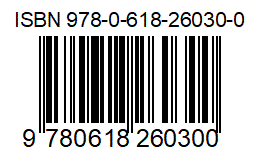
A paperback and hardcover always represent separate orderable products and should not share an ISBN. Each needs its own metadata record and, for normal retail distribution, a barcode that encodes the matching ISBN.

Large-print and accessibility editions

A large-print edition differs materially in presentation, page count, and audience. Treat it as a separate product with its own ISBN. Braille and other specialized accessible formats likewise follow the applicable product-form rules.

Spiral-bound, workbook, and special editions

A spiral-bound workbook, casebound collector edition, or edition with different bundled components is not interchangeable with the standard paperback. If it is separately available, assign a distinct ISBN and describe the format accurately.

The same paperback sold in several places

Sales channel alone does not normally create a new product. The same publisher’s unchanged paperback can use the same ISBN on the publisher’s website, at an event, and through compatible retailers and distributors.

Be careful with distribution feeds. Two print-on-demand providers distributing the same ISBN into the same wholesale channel can create record conflicts even when the ISBN itself is valid. Coordinate which provider supplies the active trade record.

Do eBooks Need ISBNs?

Are Ebooks Cheaper Than Paper Books

Not every eBook platform requires an ISBN. Amazon KDP states that an ISBN is optional for eBooks and assigns an ASIN for the Kindle listing. Other retailers, library suppliers, aggregators, or distribution workflows may require or benefit from an ISBN.

If an eBook uses an ISBN, do not reuse the paperback or hardcover ISBN. The digital publication is a different product form. Decide the digital-format plan before assignment rather than adding identifiers after files have already been distributed.

One EPUB sold through several retailers

A single EPUB product with the same publisher, content, format, and usage conditions can generally keep one eBook ISBN across multiple compatible retailers. The retailer does not automatically need a different ISBN simply because it sells the same product in another storefront.

EPUB and PDF sold as separate products

If EPUB and PDF versions are independently available and the supply chain needs to distinguish them, assign separate ISBNs. This is especially important when they have different features, pricing, pagination, distribution paths, or customer expectations.

DRM and platform-specific versions

Digital rights management can change whether two files are effectively the same product. The International ISBN Agency’s guidance distinguishes interoperable versions with substantially the same DRM settings from versions tied to a proprietary platform or carrying significantly different usage restrictions.

When an ISBN is assigned to a platform-specific or materially different DRM version, keep it separate from other digital products. If a retailer uses only its own identifier and does not require an ISBN, follow that platform’s current rules rather than creating a duplicate ISBN merely for appearance.

Minor eBook file corrections

Fixing typos, broken links, or minor formatting in the same eBook edition normally does not require a new ISBN. A substantially revised edition, changed title, new language, or materially enhanced product does.

Audiobooks and Other Audio Products

An audiobook is not the same product as the print or eBook edition. If an ISBN is used for the audiobook, it receives a separate number. A physical audio package and a separately available download may also be distinct product forms.

Narration, abridgment, language, delivery model, and bundled extras can affect the decision. An abridged performance and an unabridged performance should be clearly separated. A fully rerecorded edition with a new narrator may warrant a new ISBN when it is marketed as a new product.

Some audiobook platforms use proprietary identifiers and may not require an ISBN. Confirm the current distributor’s metadata rules before assigning one.

Editions, Reprints, and Content Updates

Unchanged reprint

Printing more copies of the same edition with no substantial change does not require a new ISBN. ISBN.org describes a reprint as additional copies with no substantial changes, perhaps including a few typo fixes.

Revised or second edition

A new edition requires a new ISBN even when the main title remains the same. Rewritten chapters, meaningful new content, a changed instructional design, a new appendix or preface that changes the product, or revisions readers would recognize as a different edition support a new identifier.

Title or publisher change

A changed title normally creates a new product record. When a different publisher republishes a title, that publisher assigns an ISBN from its own allocation; the first publisher’s ISBN remains with the first publisher’s edition.

Price or ordinary cover update

A price change does not create a new ISBN. A marketing cover refresh can usually retain the identifier when the product remains the same. Use a new ISBN when a cover, package, or bundled-content change materially alters what the customer expects to receive.

Translations and Territorial Editions

A translated edition is a different language product and receives a separate ISBN. If the same publisher sells the same English-language edition in several countries, geography alone does not necessarily multiply the ISBN count.

A different publisher licensed for another territory normally issues its own edition and ISBN. Differences in spelling, foreword, cover, pricing, or distribution do not all carry equal weight; identify whether the territorial release is truly the same publisher’s product or a separate publisher’s edition.

Bundles, Boxed Sets, and Course Packages

An independently sold boxed set or bundle can be a product in its own right and may receive its own ISBN when it meets ISBN eligibility rules. The ISBN for the set identifies the complete package, not a replacement for the identifiers on separately available component books.

A course package containing a workbook, access code, or other components requires careful product-form metadata. Assigning a new ISBN is appropriate when the package is independently orderable and materially different from the standalone book.

Do not assign ISBNs to a marketing bundle merely to track a discount. Confirm eligibility and distributor handling before numbering subscription access, serialized content, or packages dominated by non-book merchandise.

Six Worked ISBN Plans

Plan 1: One paperback

Products: one paperback. ISBNs needed: one. The barcode on the back cover encodes that paperback ISBN.

Plan 2: Paperback, hardcover, and Kindle eBook without an ISBN

Products: three. ISBNs needed from the publisher: two—one for paperback and one for hardcover. KDP assigns the Kindle ASIN; no eBook ISBN is used.

Plan 3: Paperback, hardcover, wide EPUB, and audiobook

Products: four. ISBNs needed: four when the EPUB and audiobook distribution plans use ISBNs. Each identifier maps to one product form.

Plan 4: Paperback plus separately sold EPUB and PDF

Products: three. ISBNs needed: three when both digital files are independently marketed and require ISBNs: one paperback, one EPUB, and one PDF.

Plan 5: The same paperback on the author site and through a wholesaler

Products: one unchanged paperback from one publisher. ISBNs needed: one. The sales channel does not by itself create a new ISBN, although distribution feeds must be coordinated.

Plan 6: A second edition in paperback and hardcover

New products: two. New ISBNs needed: two—one for the second-edition paperback and one for the second-edition hardcover. The first-edition ISBNs stay assigned to their historical products and are not reused.

What Multiple ISBNs Do—and Do Not Do

They separate products in the supply chain

Distinct ISBNs help retailers, libraries, wholesalers, and distributors order and describe the correct format or edition. Format-level sales reports can also be cleaner when each product is identified correctly.

They do not provide complete sales tracking by themselves

An ISBN is an identifier, not a universal analytics dashboard. Publishers still need retailer, distributor, point-of-sale, royalty, and direct-sales reports. An ISBN can be a key used in those reports, but it does not automatically capture every transaction.

They do not create copyright or publishing rights

Bowker states that an ISBN conveys no legal or copyright protection. Copyright ownership and registration are separate from ISBN assignment. Use ISBN Numbers and Copyright for that distinction.

They do not guarantee discoverability

Accurate identifiers and metadata make cataloging possible, but visibility depends on complete metadata, distribution, availability, pricing, reviews, promotion, and relevance. A book does not rank simply because it has more ISBNs.

How to Calculate and Assign Your ISBNs

  1. Create a product list, not a manuscript list. Write down every version a customer can buy separately.
  2. Mark the format or binding for each product: paperback, hardcover, EPUB, PDF, audiobook, large print, workbook, or bundle.
  3. Mark the edition and language. Separate first edition, revised edition, translation, and accessibility variants.
  4. List the publisher for each product. A different publisher’s edition uses that publisher’s identifier.
  5. List every sales and distribution platform, then note whether the platform requires an ISBN, allows one, or uses only a proprietary identifier.
  6. Check whether digital versions differ in file format, DRM, usage restrictions, or features enough to be separately identified.
  7. Remove duplicate channel rows for the exact same publisher’s product; one unchanged paperback does not need a new ISBN for every store.
  8. Add one new ISBN for each remaining eligible product that will use an ISBN.
  9. Purchase or reserve enough identifiers before cover design and metadata submission.
  10. Assign each ISBN only after the title, contributors, publisher, edition, language, format, and publication date are final.
  11. Generate a matching barcode for each physical retail product.
  12. Verify the copyright page, cover, assignment record, retailer setup, and distributor feed before publication.

Final ISBN Assignment Checklist

  • Every separately available physical binding has its own ISBN.
  • No print ISBN is reused for an eBook or audiobook.
  • The eBook plan reflects each platform’s current ISBN requirement.
  • Separately sold EPUB, PDF, or DRM-specific products are evaluated independently.
  • Translations, large-print editions, and revised editions are counted as distinct products.
  • Unchanged reprints, simple price changes, and minor typo corrections are not unnecessarily renumbered.
  • The same unchanged product is not assigned a different ISBN merely for each retailer.
  • The publisher name in the ISBN record matches the edition’s real publisher.
  • The physical barcode and copyright-page digits match the assigned ISBN.
  • The distributor feeds for a shared print ISBN will not create duplicate wholesale records.
  • Unused ISBNs remain unassigned until the product metadata is ready.
  • Old ISBNs are retained in records and never reused.

Frequently Asked Questions

Do paperback and hardcover books need different ISBNs?

Yes. They are different physical products and must be orderable separately.

Can my eBook use the paperback ISBN?

No. If the eBook uses an ISBN, assign a digital-product ISBN. Amazon KDP does not require an ISBN for eBooks and provides an ASIN, but other distribution channels may require or accept an ISBN.

Do I need a different ISBN for every eBook retailer?

Not automatically. The same EPUB product can generally use one ISBN across compatible retailers. A new identifier may be needed for separately sold file formats, proprietary DRM versions, materially different usage terms, or a platform-specific product.

Do EPUB and PDF need separate ISBNs?

Use separate ISBNs when they are independently available products that the supply chain must distinguish. If files are delivered together as one inseparable product, confirm the package rule with the relevant ISBN agency or distributor.

Does an audiobook need a separate ISBN?

It cannot use the print or eBook ISBN. Assign an audiobook ISBN when the distributor or metadata plan uses one; some platforms may rely on proprietary identifiers instead.

Does a new edition need a new ISBN?

Yes. A revised or second edition is a new product. The first edition keeps its original ISBN.

Do typo corrections require a new ISBN?

Usually not. Minor corrections can remain under the same edition and identifier. Substantial revisions require a new ISBN.

Do I need a new ISBN for a different price or retailer?

No, not when the publisher, edition, and product format remain the same. Update price or channel metadata without renumbering the product.

Can I reuse an ISBN from an out-of-print edition?

No. An assigned ISBN remains tied to the product it identified, even after that edition is no longer actively sold.

How many ISBNs should I buy?

Count the formats and editions in the next realistic publishing phase, then allow for planned future titles. Compare the Basic and Custom product terms, publisher listing, platform compatibility, and total quantity before ordering.

Final Takeaway

Multiple ISBNs matter because they separate the products readers can actually buy. Start with format, edition, language, publisher, and platform requirements. Count one identifier for each distinct product that uses an ISBN, not one for the manuscript and not one for every retailer.

That produces clean, durable metadata without wasting numbers. A paperback and hardcover get separate ISBNs; an optional KDP eBook can use an ASIN; the same wide EPUB can often keep one ISBN across retailers; and a second edition receives new identifiers for every format it replaces.

Share This Post

More To Explore

We Can Help

drop us a line and keep in touch

Cyber Monday Offer End In

Hours
Minutes
Seconds